
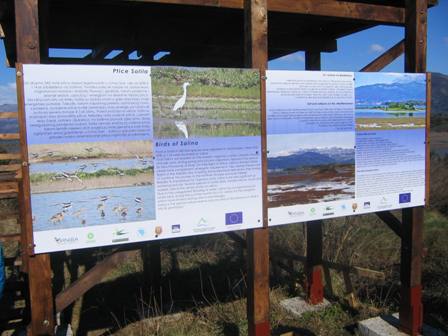
 An ornithological trail containing two bird observatories has been opened in the Tivatska Solila special bird watching reserve.
The immediate proximity to the sea and the fairly preserved geomorphology of this lagoon make it of special interest for birds. Shallow salt water rich in marine organisms and muddy bottom rich in benthos attract waterfowl for feeding, wintering, autumn and spring migration. So far, 47 species of aquatic birds have been recorded on Solili, of which 4 species are constantly present, about 35 of them winter, while 6 species are probably nesting. Together with other groups of birds, songbirds, birds of prey, etc., 111 species have been registered on Solili so far. However, the list is not nearly complete, because every year several new ones are registered for that habitat.
Considering that 526 bird species have been registered in Europe so far, the number of birds present on this lagoon makes up more than 20% of the total number of species of European ornithofauna, which is not negligible.
The importance of at least 11 species from Annex I of the EU Birds Directive, as well as several globally endangered bird species such as the plover, Phalacrocorax pygmeus, is particularly highlighted.
Special floristic and faunal reserve. Due to its importance for the survival of flora that can rarely be found anywhere today on the 800 km long eastern coast of the Adriatic, as well as the fact that it is a habitat for numerous endangered species of amphibians, reptiles and birds, Solila was protected as a special floristic and faunal reserve in 2007, the first of its kind on the Montenegrin coast and the first protected area on the coast after 1968, when a large number of beaches were protected.
Solila is the Emerald habitat of the Berne Convention and the Area of International Importance for Birds in Montenegro - IBA.
Help the birds
Artificial nests (nesting houses) are primarily inhabited by birds that nest in holes, in trees or in rock crevices. The best way to protect these birds is to preserve as many natural burrows as possible, if this is not possible we approach the creation of artificial ones. In this way, we will attract many birds to our orchards and gardens and we will be able to easily observe their daily activities.
Winter is the time of selection, when only the hardiest survive. All birds that winter in our region are adapted to frost and winter. Opinions about whether or not birds should be fed in winter are divided. In a preserved, natural environment, where the birds can easily find food on their own, additional feeding is not necessary from a biological and conservation point of view. In an environment where natural sources of food have been destroyed (for example in artificially arranged areas, in populated areas), feeding birds is not out of the question. We use feeders only during the duration of the snow cover. The seeds must remain dry, the area with the seeds must be clean. Do not add water, bread and salted food. The most suitable food is sunflower seeds, oats, corn, and other grains.
During dry periods of the year, it is preferable for birds to be provided with a waterer than any food source. Therefore, it is necessary to provide water in vessels intended for this or any other shallow bowls. Care should be taken that the containers are not deep.An ornithological trail containing two bird observatories has been opened in the Tivatska Solila special bird watching reserve.
The immediate proximity to the sea and the fairly preserved geomorphology of this lagoon make it of special interest for birds. Shallow salt water rich in marine organisms and muddy bottom rich in benthos attract waterfowl for feeding, wintering, autumn and spring migration. So far, 47 species of aquatic birds have been recorded on Solili, of which 4 species are constantly present, about 35 of them winter, while 6 species are probably nesting. Together with other groups of birds, songbirds, birds of prey, etc., 111 species have been registered on Solili so far. However, the list is not nearly complete, because every year several new ones are registered for that habitat.
Considering that 526 bird species have been registered in Europe so far, the number of birds present on this lagoon makes up more than 20% of the total number of species of European ornithofauna, which is not negligible.
The importance of at least 11 species from Annex I of the EU Birds Directive, as well as several globally endangered bird species such as the plover, Phalacrocorax pygmeus, is particularly highlighted.
Special floristic and faunal reserve. Due to its importance for the survival of flora that can rarely be found anywhere today on the 800 km long eastern coast of the Adriatic, as well as the fact that it is a habitat for numerous endangered species of amphibians, reptiles and birds, Solila was protected as a special floristic and faunal reserve in 2007, the first of its kind on the Montenegrin coast and the first protected area on the coast after 1968, when a large number of beaches were protected.
Solila is the Emerald habitat of the Berne Convention and the Area of International Importance for Birds in Montenegro - IBA.
Help the birds
Artificial nests (nesting houses) are primarily inhabited by birds that nest in holes, in trees or in rock crevices. The best way to protect these birds is to preserve as many natural burrows as possible, if this is not possible we approach the creation of artificial ones. In this way, we will attract many birds to our orchards and gardens and we will be able to easily observe their daily activities.
Winter is the time of selection, when only the hardiest survive. All birds that winter in our region are adapted to frost and winter. Opinions about whether or not birds should be fed in winter are divided. In a preserved, natural environment, where the birds can easily find food on their own, additional feeding is not necessary from a biological and conservation point of view. In an environment where natural sources of food have been destroyed (for example in artificially arranged areas, in populated areas), feeding birds is not out of the question. We use feeders only during the duration of the snow cover. The seeds must remain dry, the area with the seeds must be clean. Do not add water, bread and salted food. The most suitable food is sunflower seeds, oats, corn, and other grains.
During dry periods of the year, it is preferable for birds to be provided with a waterer than any food source. Therefore, it is necessary to provide water in vessels intended for this or any other shallow bowls. Care should be taken that the containers are not deep.
An ornithological trail containing two bird observatories has been opened in the Tivatska Solila special bird watching reserve.
The immediate proximity to the sea and the fairly preserved geomorphology of this lagoon make it of special interest for birds. Shallow salt water rich in marine organisms and muddy bottom rich in benthos attract waterfowl for feeding, wintering, autumn and spring migration. So far, 47 species of aquatic birds have been recorded on Solili, of which 4 species are constantly present, about 35 of them winter, while 6 species are probably nesting. Together with other groups of birds, songbirds, birds of prey, etc., 111 species have been registered on Solili so far. However, the list is not nearly complete, because every year several new ones are registered for that habitat.
Considering that 526 bird species have been registered in Europe so far, the number of birds present on this lagoon makes up more than 20% of the total number of species of European ornithofauna, which is not negligible.
The importance of at least 11 species from Annex I of the EU Birds Directive, as well as several globally endangered bird species such as the plover, Phalacrocorax pygmeus, is particularly highlighted.
Special floristic and faunal reserve. Due to its importance for the survival of flora that can rarely be found anywhere today on the 800 km long eastern coast of the Adriatic, as well as the fact that it is a habitat for numerous endangered species of amphibians, reptiles and birds, Solila was protected as a special floristic and faunal reserve in 2007, the first of its kind on the Montenegrin coast and the first protected area on the coast after 1968, when a large number of beaches were protected.
Solila is the Emerald habitat of the Berne Convention and the Area of International Importance for Birds in Montenegro - IBA.
Help the birds
Artificial nests (nesting houses) are primarily inhabited by birds that nest in holes, in trees or in rock crevices. The best way to protect these birds is to preserve as many natural burrows as possible, if this is not possible we approach the creation of artificial ones. In this way, we will attract many birds to our orchards and gardens and we will be able to easily observe their daily activities.
Winter is the time of selection, when only the hardiest survive. All birds that winter in our region are adapted to frost and winter. Opinions about whether or not birds should be fed in winter are divided. In a preserved, natural environment, where the birds can easily find food on their own, additional feeding is not necessary from a biological and conservation point of view. In an environment where natural sources of food have been destroyed (for example in artificially arranged areas, in populated areas), feeding birds is not out of the question. We use feeders only during the duration of the snow cover. The seeds must remain dry, the area with the seeds must be clean. Do not add water, bread and salted food. The most suitable food is sunflower seeds, oats, corn, and other grains.
During dry periods of the year, it is preferable for birds to be provided with a waterer than any food source. Therefore, it is necessary to provide water in vessels intended for this or any other shallow bowls. Care should be taken that the containers are not deep.An ornithological trail containing two bird observatories has been opened in the Tivatska Solila special bird watching reserve.
The immediate proximity to the sea and the fairly preserved geomorphology of this lagoon make it of special interest for birds. Shallow salt water rich in marine organisms and muddy bottom rich in benthos attract waterfowl for feeding, wintering, autumn and spring migration. So far, 47 species of aquatic birds have been recorded on Solili, of which 4 species are constantly present, about 35 of them winter, while 6 species are probably nesting. Together with other groups of birds, songbirds, birds of prey, etc., 111 species have been registered on Solili so far. However, the list is not nearly complete, because every year several new ones are registered for that habitat.
Considering that 526 bird species have been registered in Europe so far, the number of birds present on this lagoon makes up more than 20% of the total number of species of European ornithofauna, which is not negligible.
The importance of at least 11 species from Annex I of the EU Birds Directive, as well as several globally endangered bird species such as the plover, Phalacrocorax pygmeus, is particularly highlighted.
Special floristic and faunal reserve. Due to its importance for the survival of flora that can rarely be found anywhere today on the 800 km long eastern coast of the Adriatic, as well as the fact that it is a habitat for numerous endangered species of amphibians, reptiles and birds, Solila was protected as a special floristic and faunal reserve in 2007, the first of its kind on the Montenegrin coast and the first protected area on the coast after 1968, when a large number of beaches were protected.
Solila is the Emerald habitat of the Berne Convention and the Area of International Importance for Birds in Montenegro - IBA.
Help the birds
Artificial nests (nesting houses) are primarily inhabited by birds that nest in holes, in trees or in rock crevices. The best way to protect these birds is to preserve as many natural burrows as possible, if this is not possible we approach the creation of artificial ones. In this way, we will attract many birds to our orchards and gardens and we will be able to easily observe their daily activities.
Winter is the time of selection, when only the hardiest survive. All birds that winter in our region are adapted to frost and winter. Opinions about whether or not birds should be fed in winter are divided. In a preserved, natural environment, where the birds can easily find food on their own, additional feeding is not necessary from a biological and conservation point of view. In an environment where natural sources of food have been destroyed (for example in artificially arranged areas, in populated areas), feeding birds is not out of the question. We use feeders only during the duration of the snow cover. The seeds must remain dry, the area with the seeds must be clean. Do not add water, bread and salted food. The most suitable food is sunflower seeds, oats, corn, and other grains.
During dry periods of the year, it is preferable for birds to be provided with a waterer than any food source. Therefore, it is necessary to provide water in vessels intended for this or any other shallow bowls. Care should be taken that the containers are not deep.

.jpg&w=2048&q=75)